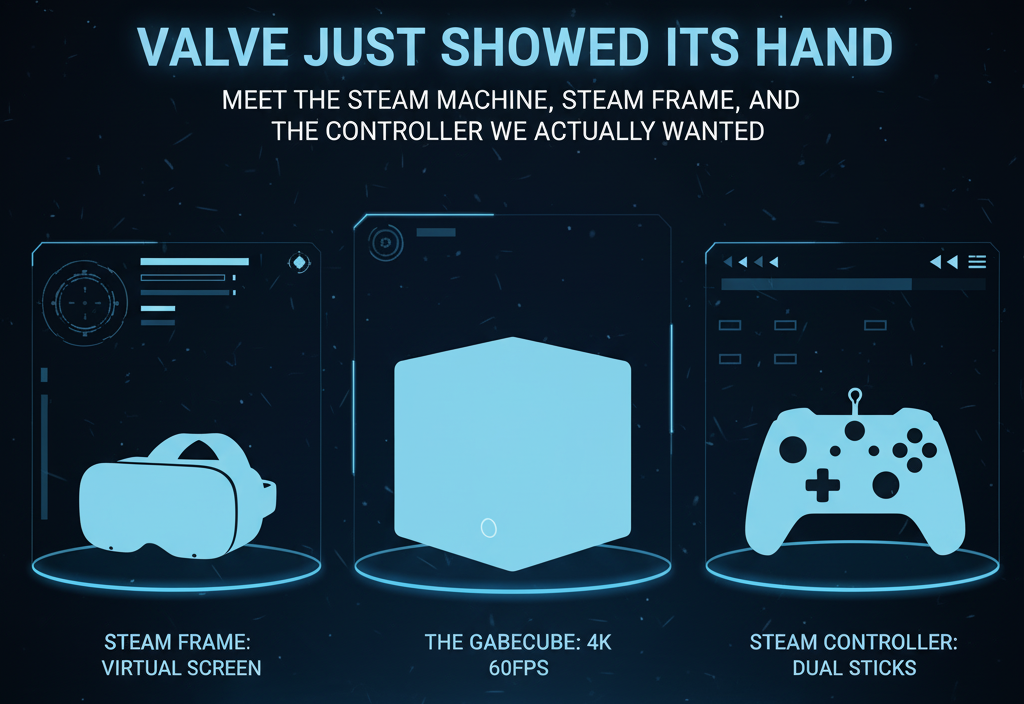
Valve Just Showed Its Hand: Meet the Steam Machine, Steam Frame, and the Controller We Actually Wanted
Alright, you beautiful people, pull up a chair. For the past few years, the entire conversation around Valve’s hardware has been “Steam Deck, Steam Deck, Steam Deck.” We’ve been so focused on handhelds that we forgot one crucial thing: Gabe Newell plays chess, not checkers.
Yesterday, Valve didn’t just announce a new product; they unveiled an entire ecosystem. They’ve officially pulled back the curtain on three new pieces of hardware set for 2026: the Steam Machine, the Steam Frame VR headset, and a fully revised Steam Controller.
This isn’t just an update. This is a full-scale invasion of every screen in your house, from your desk to your couch to the literal-virtual-reality-space in front of your face. And honestly? It’s about time.
The “GabeCube”: Steam Machine is Back from the Dead
Remember the 2015 Steam Machines? Of course you don’t. They were a confusing, underpowered mess that quietly vanished. Well, Valve is bringing the name back, and this time, they’re not messing around.
This new Steam Machine is a compact, 6-inch (160mm) cube designed to live under your TV. But don’t let the size fool you. Valve is claiming this box is “over 6x more powerful than Steam Deck”.
- The Guts: It’s powered by a semi-custom AMD Zen 4 CPU and an RDNA3 GPU.
- The Power: It boasts 16GB of DDR5 RAM plus 8GB of GDDR6 VRAM.
- The Promise: Valve is explicitly targeting 4K gaming at 60 FPS (using FSR) and full ray tracing support.
- The OS: It runs the same slick, console-like SteamOS as the Steam Deck, meaning fast suspend/resume and your entire library, ready to go.
My Take (The Psychology): This is a direct shot at PlayStation and Xbox. Valve learned from the Steam Deck that convenience is king. People want their massive Steam library, but they also want to play on the couch with a controller. This is Valve’s answer. By making a powerful, simple, and (hopefully) competitively priced box, they’re creating a trojan horse. They’re not just selling a console; they’re selling the entire Steam platform as a living room competitor. And with models coming in 512GB and 2TB, they’re ready for our massive game libraries.
Steam Frame: The Standalone VR Headset We’ve Been Waiting For
This might be the real showstopper. The Steam Frame is Valve’s next-gen VR headset, but it’s not the Valve Index 2. It’s something much, much smarter.
The Steam Frame is a standalone, wireless VR headset powered by a Snapdragon processor and running SteamOS, just like a Steam Deck. This is a massive psychological shift. It’s designed to stream your entire Steam library—VR and non-VR games alike—on a virtual 2D screen.
It’s lightweight (440g with the strap), has a high-resolution 2160×2160 per-eye display, and a 144Hz refresh rate. It even has eye-tracking to power “foveated streaming,” which sends the highest resolution only where you’re looking, saving bandwidth. While it’s a standalone device, its main purpose is to stream games wirelessly from your PC with a dedicated, low-latency connection.
My Take: Valve is basically saying, “Why buy a $500 PlayStation Portal to play games on a tiny screen when you can buy this and play your entire PC library on a virtual 100-inch IMAX screen?” It’s a Quest 3 rival aimed squarely at the hardcore PC gamer.
Steam Controller: This Time, With Two Sticks!
Yes, you read that right. The new Steam Controller has two (2) thumbsticks. Valve finally listened.
It’s inspired by the Steam Deck’s layout, featuring full-sized controls, two trackpads, gyro, and grip buttons. It also has next-gen magnetic thumbsticks for better reliability, HD haptics, and a 35+ hour rechargeable battery. This controller is designed to be the single, unified input method for your PC, your Steam Deck, your new Steam Machine, and even the Steam Frame.
But What About the Steam Deck 2?
Ah, the question on everyone’s mind. Valve addressed this directly. A Steam Deck 2 is not the focus right now.
Why? Because Valve doesn’t want to make a small, 20-30% performance jump. They are waiting for a significant leap in chip technology that can deliver a “worthwhile enough performance upgrade” without destroying battery life. Battery life is still the Steam Deck’s “massive problem,” and Valve wants to solve that before releasing a true sequel.
My Final Take: This is a brilliant, multi-pronged attack on the entire gaming market. Valve is using the trust and goodwill they built with the Steam Deck to launch a full-on “Steam Everywhere” hardware family. They’re targeting the living room, the VR space, and our hands all at once. The only piece of the puzzle they’re (annoyingly) holding back? The price.
But with a planned launch for all three in early 2026, the next year in gaming just got infinitely more interesting. Your move, Microsoft and Sony.